
Two customer evaluations across organoid and cell-banking workflows demonstrate that Revella Cell Thawing System delivers nearly identical cell growth performance to conventional water baths — with less contamination risk and full traceability.
For decades, the water bath has been the standard tool for thawing cryopreserved cells. It is familiar, accessible, and inexpensive.
But it is also open, unstandardized, and increasingly unsuitable for GMP-grade cell therapy workflows. Operator-dependent technique, lack of traceability, and contamination risk have pushed many labs to ask:
Can a water-free thawing system deliver the same cell performance — with better process control?
CellStore recently commissioned two independent customer evaluations to answer exactly this question. The results are clear: across organoid and cell-banking workflows, Revella delivered cell growth performance nearly identical to conventional water bath thawing — while offering a cleaner, more traceable, and GMP-friendly workflow.
Parameter | Detail |
Format | 0.5 mL cryovials |
Sample size | 3 batches |
Comparison | Revella vs. water bath |
Time points | Day 0 (baseline) and Day 4 |
Assessment | Post-thaw morphology and apparent growth |
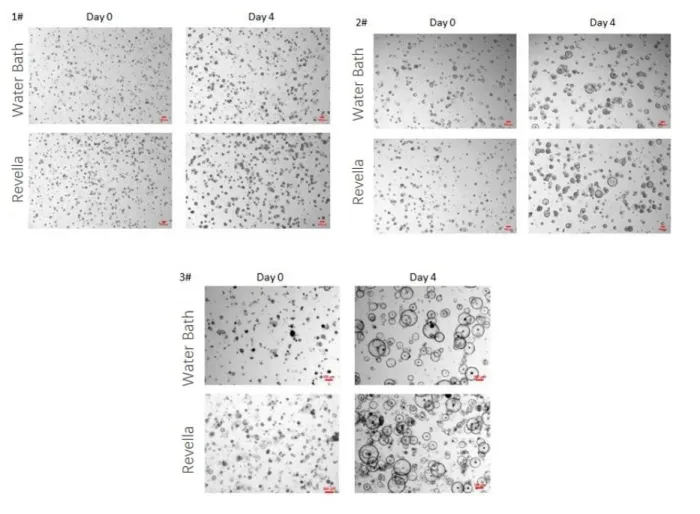
Outcome: Across all three batches, Revella and water-bath samples showed visually comparable morphology and apparent growth at Day 4. The customer reported “nearly identical performance” between the two methods.
Why this matters: Organoids are three-dimensional structures that are particularly sensitive to thermal stress. The fact that Revella — a dry-heating system — produced equivalent morphological outcomes suggests that the controlled thawing environment does not compromise the structural integrity of complex biological samples.
Parameter | 1.0 mL Format | 1.5 mL Format |
Clones evaluated | 6 | 4 |
Total vials | 22 | 16 |
Concentration range | 0.6–2.0 × 10⁷ cells/mL | Uniform 3.0 × 10⁷ cells/mL |
Passages tracked | P0–P2 | P0–P2 |
Assessment | VCD, viability, growth profiles | VCD, viability, growth profiles |
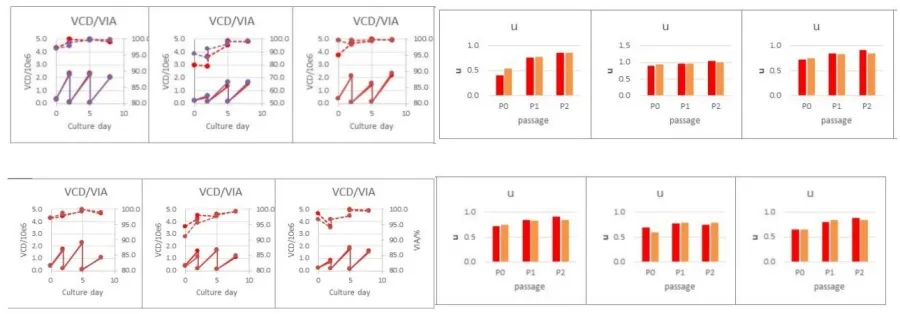
Outcome: VCD, viability, and passage-level growth profiles were closely aligned between the two thawing methods. The customer reported “nearly identical cell-growth performance” over three passages.
Why this matters: Cell banking requires reproducible recovery across multiple clones, vials, and passages. The close alignment between Revella and water-bath thawing across 10 clones and 38 vials demonstrates that Revella can support consistent, scalable cell-banking workflows without compromising cell quality.
Metric | Result |
Total vials tested | 38 |
Total clones evaluated | 10 |
Passages tracked | P0–P2 |
Workflows covered | Organoid + Cell banking |
Conclusions | “Nearly identical” in both cases |
The customer evaluations confirm that Revella’s thawing mechanism delivers cell performance equivalent to water baths. This is enabled by:
Direct-contact dry heating — eliminates open-water exposure and contamination risk
Real-time infrared monitoring — ±0.1°C temperature accuracy during thawing
Automatic endpoint control — reduces operator-dependent variability
2 mL & 5 mL cryovial compatibility — flexible for different formats
The result: Consistent, reproducible thawing with full traceability — without the contamination risk and process variability associated with traditional water baths.
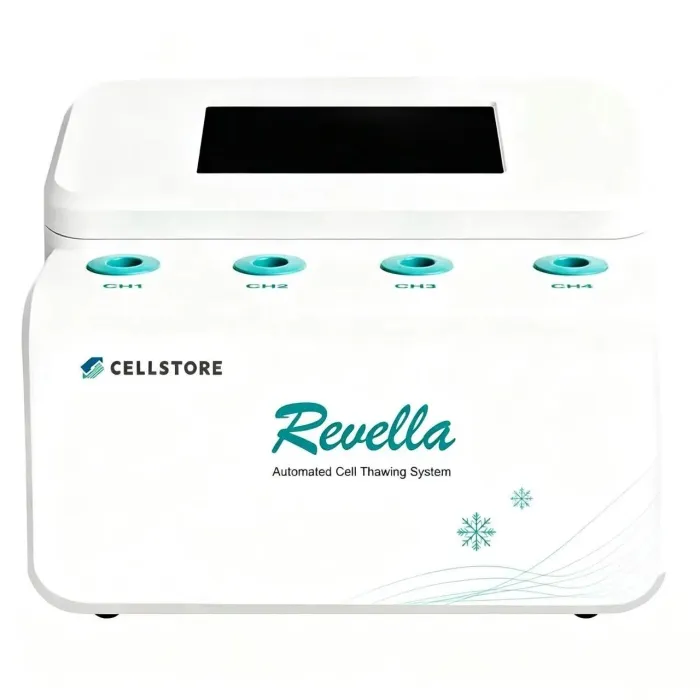
The customer cases support evaluating Revella as a water-free alternative. CellStore recommends a four-step qualification approach:
Step 1 — Match the container
Confirm your vial format, fill volume, and adapter fit.
Step 2 — Match the thaw SOP
Define endpoint, handling window, and operator steps.
Step 3 — Confirm cell quality
Assess recovery, viability, phenotype, and function.
Step 4 — Run a side-by-side comparison
Qualify Revella against your current thawing SOP using your own cell lines and readouts.
The transition from water-bath thawing to a water-free system is not about replacing a familiar tool. It is about reducing contamination risk, increasing traceability, and standardizing a critical process step — without compromising cell quality.
Across organoid and cell-banking workflows, Revella has demonstrated that water-free thawing can deliver “nearly identical” performance to water baths. That is the starting point for qualification — and the foundation for a more controlled, reproducible thawing workflow.
Learn more or request a qualification plan: Contact CellStore