
Following our previous post on extended 4°C holding, we also looked at what happens after thawing.
In many MSC workflows, cells do not move directly from thawing to the next step. They may need to wait for QC release, downstream handling, or clinical scheduling. Under room-temperature holding conditions, this waiting period can quickly become a critical risk.
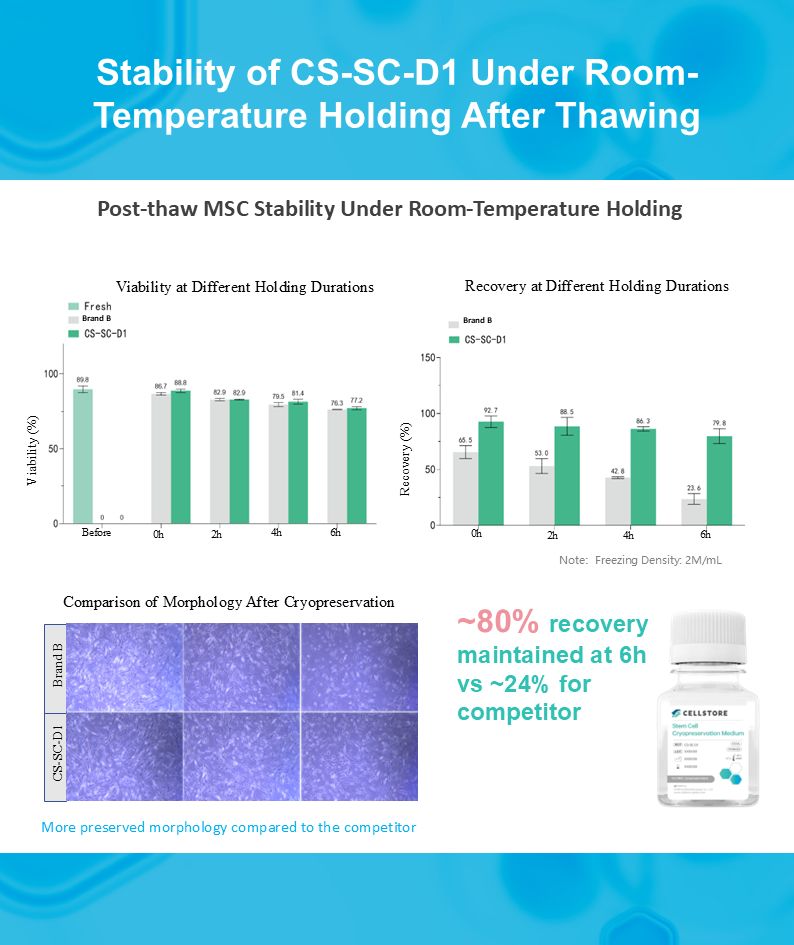
To better reflect this scenario, we compared CS-SC-D1 Stem Cell Cryopreservation Medium with a mainstream competitor under room-temperature holding conditions.
The results were clear:
✔️ Viable cell recovery reached 86.3% at 4h
✔️ Recovery remained 79.8% at 6h
✔️ The competitor dropped sharply to 23.6% at 6h In addition, cells preserved with CS-SC-D1 maintained a more normal spindle-like morphology after cryopreservation.
What this means in practice:
When post-thaw delays happen, CS-SC-D1 helps cells remain more stable for longer. For industrial MSC workflows, this translates into:
✅ better tolerance for unavoidable delays
✅ lower risk during downstream handling
✅ improved batch-to-batch consistency
Cryopreservation is not only about freeze–thaw performance. It is also about how cells behave when real workflows do not move exactly on time.

 Cryopreservation Media