
Email Us

In PBMC cryopreservation, post-thaw viability is important — but it does not always tell the full story. 


 A more practical question is: 

Can thawed PBMCs remain usable, dispersible, and aggregation-free during real post-thaw handling? 


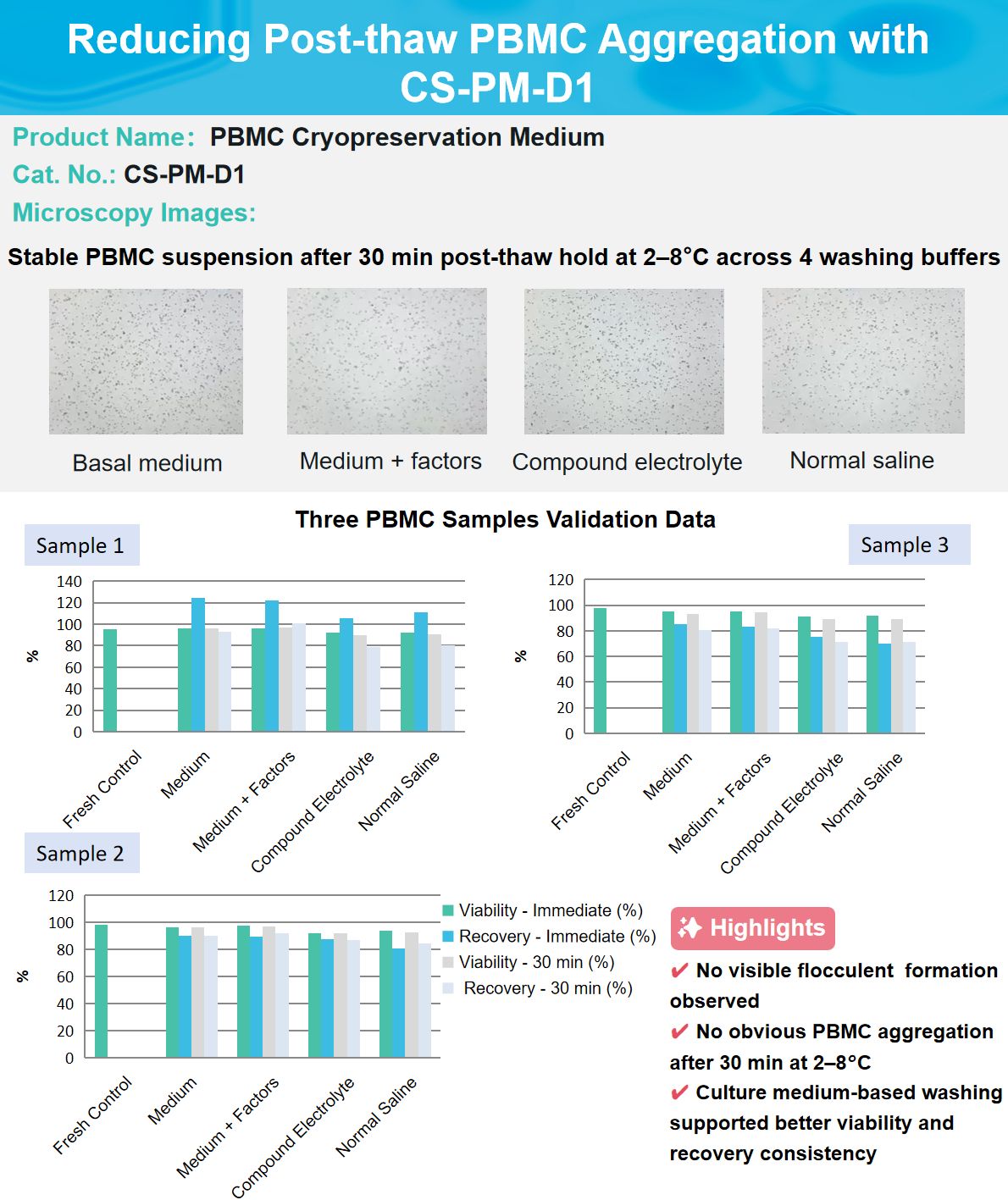
 Recently, we evaluated CS-PM-D1 PBMC Cryopreservation Medium under a practical lab scenario: PBMC samples were held at 2–8°C for 30 minutes after thawing before the next processing step. 


 To better reflect real workflow variability, the evaluation included three independent PBMC samples and four washing buffer conditions: basal medium, medium with factors, compound electrolyte solution, and normal saline. 


 The results were encouraging: 

✔ No visible flocculent formation immediately after thawing 

✔ No obvious PBMC aggregation after 30 minutes at 2–8°C 

✔ Stable suspension performance across all four washing buffer conditions 

✔ Culture medium-based washing supported better viability and recovery consistency 


 For us, this case reinforces one key point: 

PBMC cryopreservation should not only be evaluated by a single viability number, but by whether cells remain usable for what comes next — washing, centrifugation, culture, analysis, or downstream cell processing. 


 At CellStore, we continue to develop cryopreservation media around real workflow needs, supporting both cell survival and post-thaw usability in sensitive cell applications. 


 Because sometimes, the real value of a cryopreservation medium is not only helping cells survive freezing. 


It is helping them stay ready for the next step.

cells-need-to-be-more-than-alive-after-thawing.jpg


Related Cryopreservation Media
Quick Links
What Is Mesenchymal Cryopreservation Medium? Customer Case|CS-PM-D1 Enables High-Quality CBMC Cryopreservation Key Points for Evaluating Cryopreservation Effectiveness and Sample Transfer CellStore Stem Cell Cryopreservation Medium: Powering China's Stem Cell Therapy Revolution in 2025 Critical Considerations for Effective Cryopreservation of Cells and Tissues: from Experimental Design to Protocol Execution Reshaping the Microcosm of Life: Let 3D Models Say Goodbye to the "Frostbite" Era How to Freeze and Thaw Cells with Cell Freezing Medium? How to Choose the Right Tissue Culture Media? Cryopreservation Best Practices 8 Components of Tissue Culture Media Homemade freezing medium or commercial freezing medium? Simplifying PBMC Cryopreservation without Compromise — Application 1 Simplifying PBMC Cryopreservation: Direct Freezing of Whole Blood Application 2 How Does Cryopreservation Media Protect Cells During Freezing and Long-Term Storage? Cryopreservation of Embryos Advantages What Is Cryopreservation of Stem Cells and Is It Worth It? Does Cryopreservation Impact T Cell Viability and Therapeutic Efficacy? A Stable Freeze–Thaw Step Can Make All The Difference In Cd34⁺ Cell Workflows. Why Does “dead volume” Still Challenge Automated Cgt Manufacturing — And How Can We Design Around It Instead Of Fighting It? Case Sharing | Clinical Application: Performance Interpretation of CS-SC-D1 Cryopreservation Medium Technology Sharing | Rethinking CHO Cell Banking: Toxicity, Workflow Burden & Simpler Operations CS-DX-N2 Keeps >90% Of Cells Alive, With Markers Virtually Unchanged From Fresh What Happens to Cell Viability After 3–6 Months of Cryopreservation? Cryopreservation Challenges in iMSC Cell Therapy Workflows Cryopreservation for CAR-NK Cells: Functional Retention Matters Stability Under Extended 4°C Holding In Msc Manufacturing Post-Thaw Stability Under Room-Temperature Holding In Msc Manufacturing Beyond Viability: Evaluating PBMC Cryopreservation from a Post-Thaw Workflow Perspective Understanding PBMC Freezing and Culture New product launch — meet AirLite Cells need to be more than alive after thawing
Email
lumy@cellstore-global.com
Tel
010-82170580
Address
5-101, Bldg. 10, No. 6 Dongsheng Science and Technology Park North St., Haidian Dist., Beijing, China.